
Six people told me to buy a Levoit air purifier before I finally did, and I brushed off every one of them because I pictured a purifier as one of those humming boxes in the corner that mostly makes you feel better about the dust you can still see on your desk. Then wildfire smoke settled over our valley for eight straight days last fall, my home office windows had to stay shut the whole time, and my daughter's allergies flared up badly enough that I finally ordered one out of plain desperation.
This isn't the six month feel good writeup with a tidy mobility chart and a happy conclusion. That review exists elsewhere on this site if you want it. This is the honest version, the one where I tell you what the box doesn't, including the parts of owning a Levoit that nobody mentions until you've already run it for a season and started replacing filters.
I mention all that upfront because context matters here. If you work from a huge open loft with vaulted ceilings, or you're hoping a single unit will handle allergens for an entire house, none of what follows is going to convince you this is the right tool. If you work from a normal sized room with a door, and you deal with dust, pet hair, or the occasional smoky week, keep reading.
The Quick Verdict
A genuinely capable HEPA purifier for a real room, just don't expect it to hit the sticker's coverage number or stay whisper quiet on high.
Amazon Check Today's Price →Stuffy Office, Same Old Excuses? Here's What Actually Clears the Air.
Candles and cracked windows mask a stuffy room for about twenty minutes. A proper HEPA purifier actually pulls the dust, pet hair, and smoke particles out of the air you're breathing at your desk all day.
Amazon Check Today's Price on Amazon →How I've Used It
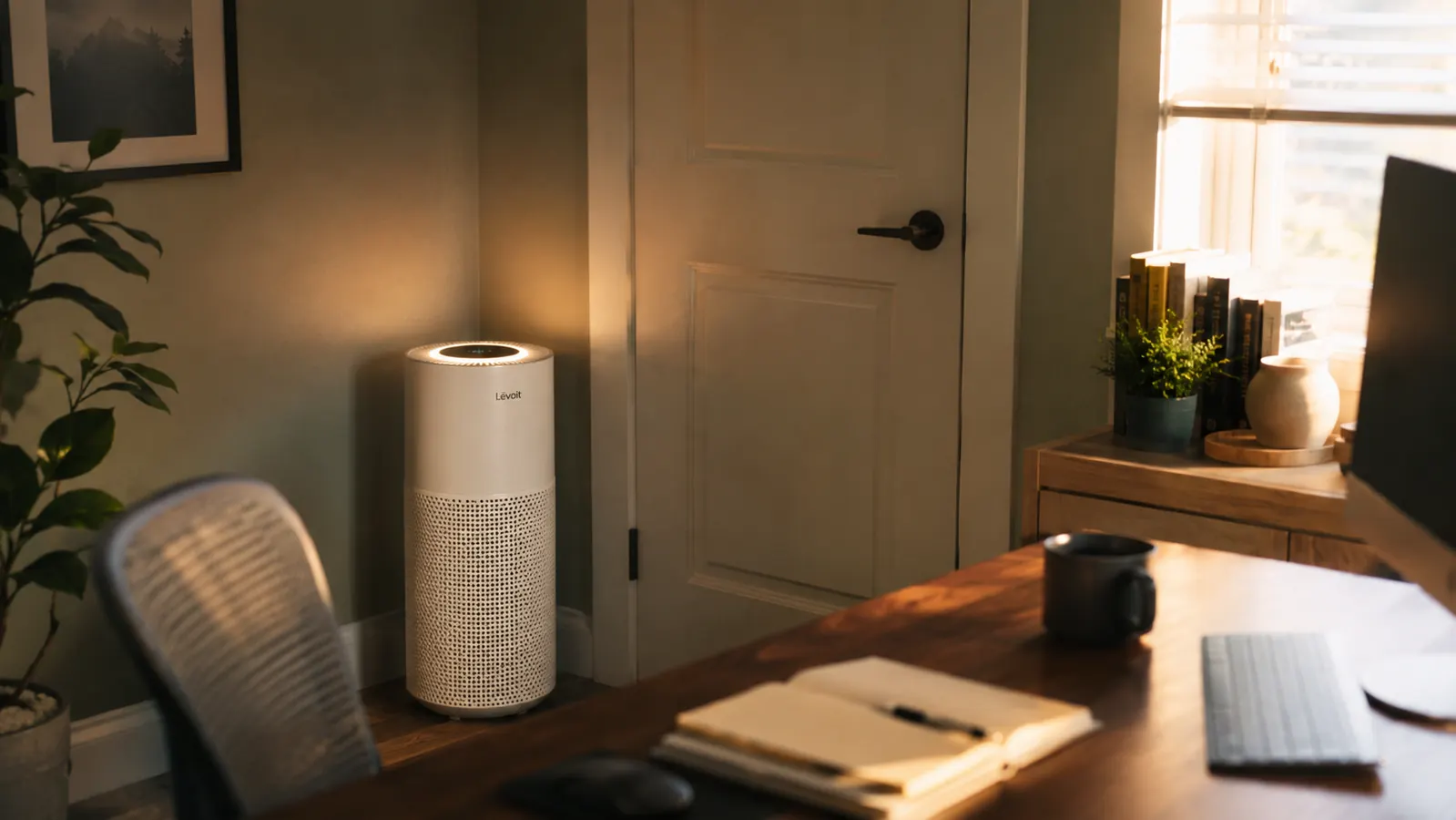
My office is a converted spare bedroom, about 130 square feet, with an actual door I can close, which matters a lot for how a Levoit performs. I've had mine running nearly every day for about five months, through the tail end of pollen season and into the start of wildfire smoke season here.
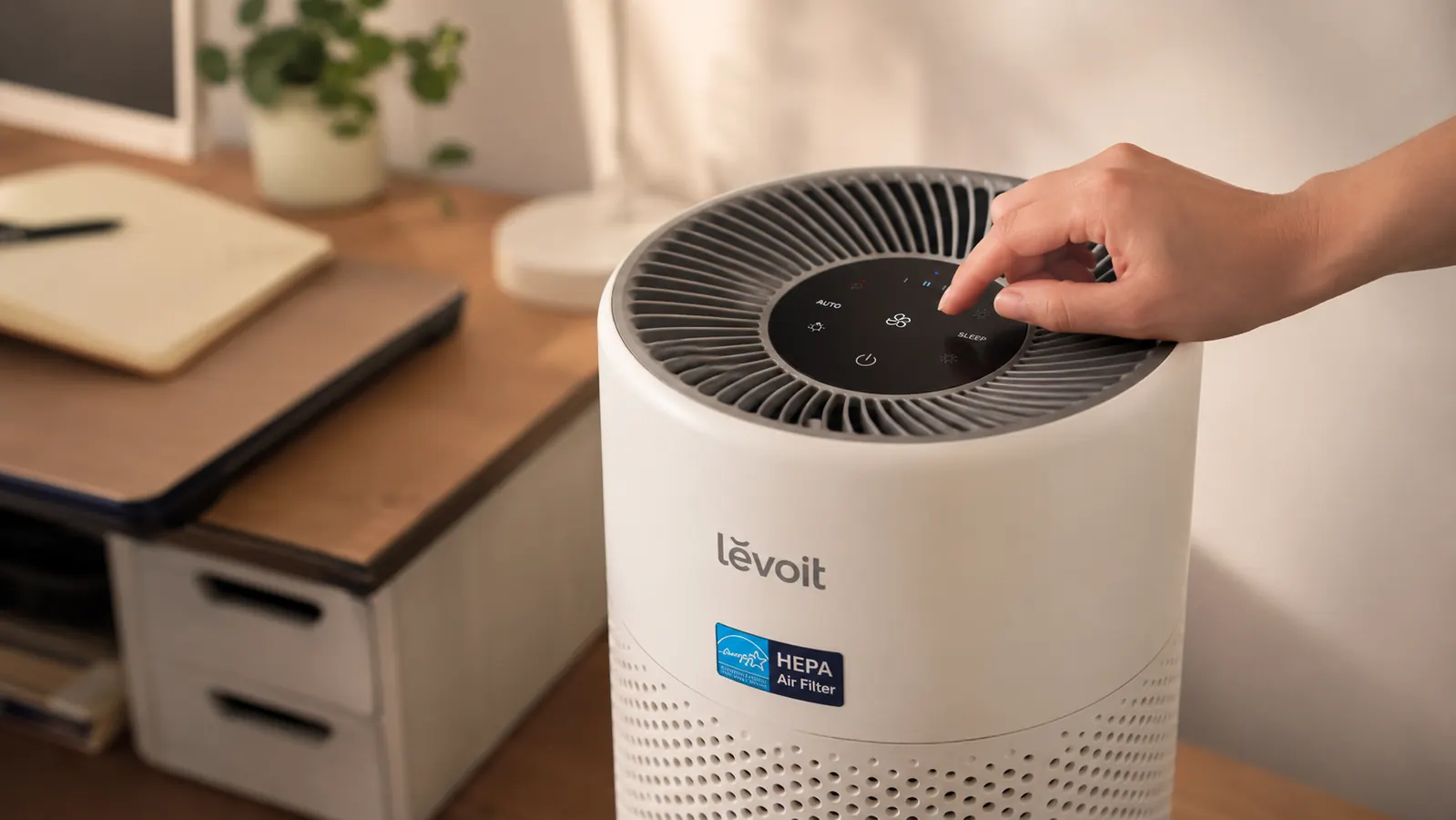
I run it on auto mode most days, which uses the built in sensor to ramp the fan speed up or down based on how much particulate matter it detects in the room. Overnight I switch it to sleep mode, which dims the display and caps the fan speed low. During the worst smoke week I bumped it to the highest setting for a few hours at a stretch just to see what it could actually do.
I also keep a cheap PM2.5 monitor on my bookshelf, not because I'm particularly technical, but because I wanted a second opinion on whether the purifier's own readout was telling me the truth. That habit is where most of what follows in this review actually came from.
I didn't rearrange my whole office around it either, which is worth saying because some reviews make it sound like you need to redesign your workspace to get results. Mine sits on the floor next to my bookshelf, a few feet from my desk chair, plugged into the same power strip as my desk lamp. No special placement required, just enough open space around it that air can actually pull in from more than one side.
The Number on the Box Isn't the Whole Story
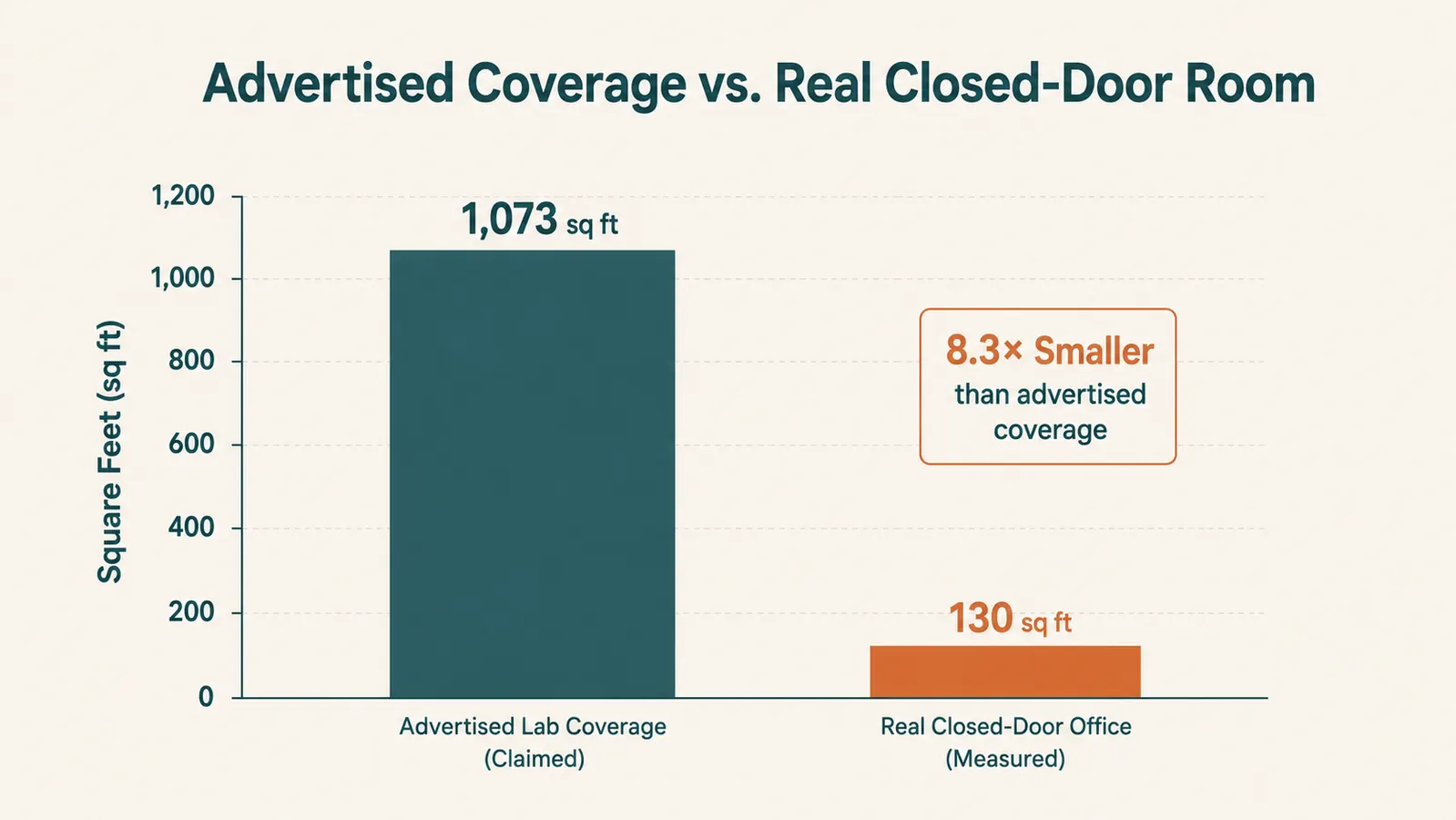
Levoit advertises this unit as covering up to 1073 square feet, and that number is technically accurate, the same way a car's advertised highway mileage is technically accurate. It's measured under lab conditions, at a specific air changes per hour rate, in an empty room with no furniture, doors, or hallways interrupting airflow. My office is 130 square feet with a door I keep shut, and even there, on auto mode, it takes the unit a solid twenty to thirty minutes to bring the reading on my separate monitor back down after I've had the door open.
If you're shopping based on that 1073 figure and picturing it clearing your whole downstairs, open concept living room included, you're going to be disappointed. Buy it for the room it's actually going to sit in, closed door, normal furniture and all, and cut the marketing number by more than half in your head before you decide it's big enough.
This isn't really a Levoit specific problem, every purifier brand does the same math on their box. But since nobody printed a warning sticker on mine, I'm printing one here instead.
For what it's worth, the manufacturer isn't hiding this math, it's printed in the fine text of most listings if you scroll far enough, and any purifier brand publishing a CADR number is telling you the same story if you know how to read it. The problem isn't dishonesty, it's that almost nobody reads that far down the page before clicking buy, myself included the first three times I shopped for one.
The Filter Replacement Cost Nobody Mentions at Checkout
The HEPA filter isn't a lifetime part. Levoit recommends swapping it every six to eight months depending on how dusty your air is and how many pets are shedding into it, and mine, running near daily in a house with two cats, lands closer to the six month end of that window. That's a recurring cost that never shows up anywhere near the product photos.
It's not a dramatic expense in isolation, but it's also not nothing, and it's the kind of ongoing cost that changes the real math on this purchase versus what you saw on the listing page. Budget for a fresh filter roughly twice a year and you won't be caught off guard six months in.
The one thing I'll say in its defense is that the filter is genuinely easy to swap, no tools, no fuss, out with the old cartridge and in with the new one in under a minute. Some purifiers make you feel like you need a manual just to open the housing. This one doesn't.
I've now been through one full filter change, and the process took less time than unloading the dishwasher. What actually surprised me was how visibly gray the old filter looked coming out, which did more to convince me the thing was working than any reading on the display ever did.
The Sound at Night Is Real, Here's What It Actually Sounds Like
On sleep mode, this thing is close to silent, a soft whoosh of air that's easier to ignore than a box fan on its lowest setting. That part of the marketing holds up. But sleep mode also means the fan is capped low, so on a bad smoke night it isn't clearing the room nearly as fast as it could.
Bump it up to speed three or four and the sound goes from a background hum to a noticeable whir, the kind that's fine for a work call on mute but distracting if you're trying to fall asleep next to it. On the highest setting it's genuinely loud, closer to a box fan on high than anything you'd call quiet.
Nobody puts a decibel chart on the front of the box, so here's the honest version: quiet enough for sleep on the low settings, not quiet at all if you ever need the full power the 1073 square foot number implies you'd need.
If noise is a dealbreaker for you, plan on running it on auto or sleep mode almost exclusively and treating the top speed as an emergency setting for a genuinely bad air day, not an everyday setting you'll live with.
What It Won't Fix (I Wasted a Month Expecting It To)
I spent the first few weeks assuming the purifier would also handle the faint musty smell that shows up in my office every spring, the one that comes from a slow leak we still haven't tracked down under the window. It didn't. A HEPA filter is built to trap particles, dust, pet dander, pollen, some smoke particulate. It is not built to solve a humidity or mold source problem, and running it constantly next to a damp wall just meant I was purifying air that kept getting recontaminated at the source.
It also won't do much for gases and odors on its own the way a dedicated activated carbon filter would, unless the model you buy specifically includes one layered in. Check the filter description before you buy if odor control, not just particles, is your main goal.
None of this is a knock on the purifier, it's doing exactly what a HEPA purifier is designed to do. It's a knock on my own expectations, and I'd rather you set yours correctly before you spend money assuming this one gadget replaces an actual repair.
The lesson that stuck with me is a boring one: a purifier cleans air, it doesn't fix a building. If your stuffy room problem is really a leak, a vent that never gets cleaned, or a carpet that's overdue for a deep clean, buy this to help while you also handle the actual source.
A cheap dehumidifier next to a damp wall did more for that musty smell in a weekend than three straight months of running the purifier ever did, which is the kind of pairing I wish someone had told me about before I burned a month assuming one gadget could do a two gadget job.

The App and Auto Mode Have Their Quirks
Setup was straightforward, connect to your home WiFi, add the device in the Levoit app, done in a few minutes. Where it gets less smooth is the auto sensor itself, which occasionally overreacts to something totally harmless, like the smell of dinner cooking two rooms away, and ramps the fan up like there's a real air quality event happening in my closet.
The app itself is fine for checking filter life and switching modes remotely, but I've had it lose connection to the unit a handful of times over five months, requiring a quick reconnect. It's a minor annoyance, not a dealbreaker, but if you're expecting rock solid smart home integration, temper that expectation a little before you build your whole routine around the app.
None of these quirks are severe enough to make me regret buying it, but I'd rather you go in knowing the smart features are a nice bonus layered on top of a genuinely solid purifier, not the main reason to buy one in the first place.
What I Liked
- HEPA filtration genuinely reduces dust and pet dander in a real, closed room
- Sleep mode is quiet enough to run overnight without noticing it's on
- Filter swaps take under a minute, no tools required
- Auto mode adjusts fan speed on its own most of the time without babysitting
- Handles a smoke-heavy week noticeably better than running nothing at all
Where It Falls Short
- The 1073 sq ft coverage claim is a lab number, real-world coverage behind a closed door is far smaller
- High speed settings are genuinely loud, not whisper quiet like the low settings
- Replacement filters are a recurring cost the product page doesn't highlight
- Won't touch musty or mold-source odors, only particulates
- WiFi connection to the app has dropped occasionally
The box promises a number. The room you actually own is smaller, has a door, and has real furniture in it. Buy for that room, not the number.
Who This Is For
This makes the most sense for anyone working out of a smaller, closable room who deals with real allergens, pet dander, seasonal pollen, or the occasional smoke-heavy week, and wants a purifier that's actually quiet enough to leave running while they work or sleep. If you keep a pet in the house and your home office doubles as a place you spend eight hours a day breathing, this earns its spot on the floor. It's also a solid fit if you're sensitive to noise at night but still want something running while you sleep, since the low settings are quiet enough to disappear into the background within the first few nights.
Who Should Skip It
Skip this one if you're trying to cover an open floor plan or a large multi room area, the coverage claim won't hold up there and you'll be disappointed with how little it seems to do. Skip it too if odor and mold smell, not dust and dander, are your main complaint, since a standard HEPA filter isn't built to solve that on its own. And skip it if you're expecting a fully hands-off smart home experience, the app is a helpful extra, not something to build your whole routine around.
Still Breathing the Same Stale Office Air? That's an Easy Fix Now.
You don't need to guess anymore whether this one's worth it. You know the real coverage, the real noise level, and the real filter cost going in, which is more than most reviews will ever tell you.
Amazon Check Today's Price on Amazon →